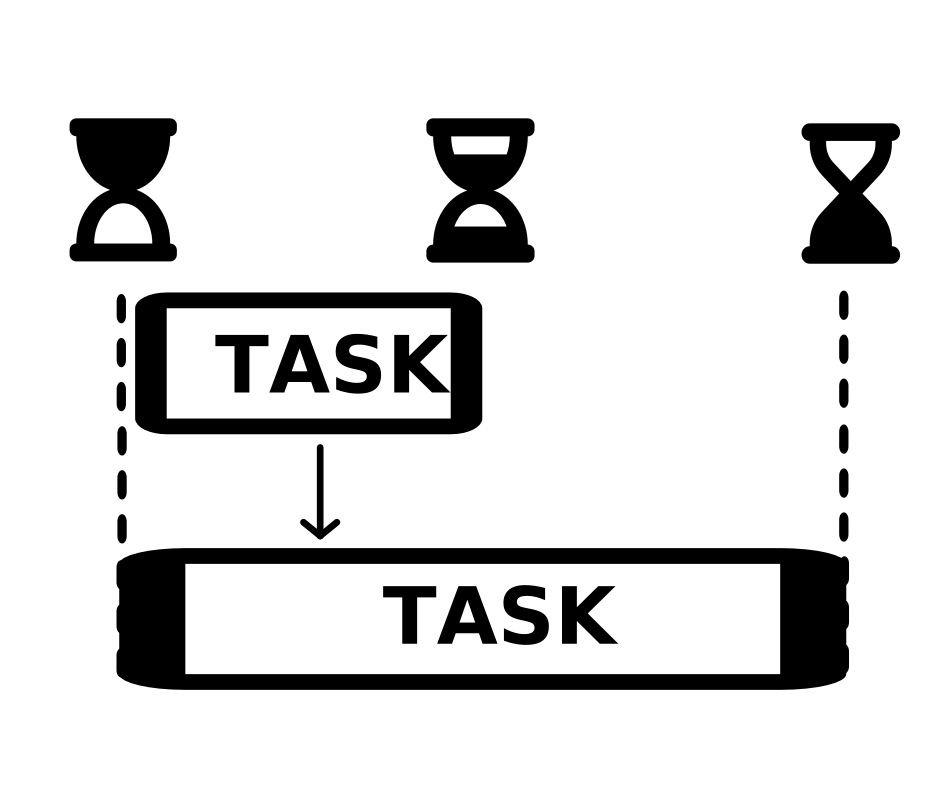
Parkinson's Law
What is it?
Parkinson’s Law states that work expands to fill the time available for its completion.
Where Did It Come From?
Parkinson’s Law was introduced in 1955 by a British historian named C. Northcote Parkinson. He originally noticed this pattern in government bureaucracy: as more time and staff were allocated to administrative work, the amount of paperwork and procedures grew — even when there was no real increase in necessary work.
He summarized his observation with the famous phrase:
“Work expands so as to fill the time available for its completion.”
Over time, people realized this idea applies not just to governments, but also to personal tasks, schoolwork, and business projects.
Simple Examples
Homework: If a teacher gives you two weeks to write a short essay, many students wait until the last few days to start. But if the same essay is due tomorrow, it often gets done in a single evening.
Cleaning: If you plan to clean the house on Saturday with no time limit, it may take all day. But if guests are arriving in 30 minutes, the essential cleaning gets done very quickly.
Office work: A report that could be written in two hours might take all day if there’s no strict deadline.
Key Takeaway
Giving a task more time does not guarantee better results — it usually just makes the task take longer.
Parkinson’s Law states that work expands to fill the time available for its completion. Formulated by British historian C. Northcote Parkinson in 1955, the law originally described bureaucratic behavior but has since been widely applied to personal productivity, project management, and organizational design.
From a psychological perspective, Parkinson’s Law is closely related to procrastination dynamics and time perception. When deadlines are distant, motivation and urgency remain low, leading individuals to pace their effort inefficiently. As the deadline approaches, perceived time scarcity increases focus and effort — a phenomenon supported by research in behavioral economics and cognitive psychology.
In management science, Parkinson’s Law connects with Lean thinking and Critical Chain Project Management (CCPM). Lean methodologies aim to eliminate waste — including wasted time — while CCPM explicitly addresses inflated task durations by aggregating safety buffers instead of embedding them in every task.
It also relates to the Student Syndrome, where people delay starting tasks until the last possible moment, and to Hofstadter’s Law, which humorously states that complex tasks always take longer than expected — even when accounting for Hofstadter’s Law. Together, these principles illustrate systematic human biases in estimating and using time.
In economics and organizational theory, Parkinson’s Law complements Parkinson’s Second Law, which observes that expenditure rises to meet income, and aligns with resource slack theory, where surplus resources encourage inefficiency rather than improvement.
In short, Parkinson’s Law reflects a consistent pattern: time availability shapes behavior more than task difficulty does.
References
- Parkinson, C. N. (1955). Parkinson’s Law. The Economist.
- Parkinson, C. N. (1957). Parkinson’s Law: The Pursuit of Progress. John Murray.
- Kahneman, D. (2011). Thinking, Fast and Slow. Farrar, Straus and Giroux.
- Goldratt, E. (1997). Critical Chain. North River Press.
- Womack, J. P., & Jones, D. T. (1996). Lean Thinking. Simon & Schuster.
- Steel, P. (2007). The Nature of Procrastination. Psychological Bulletin, 133(1), 65–94.
- Hofstadter, D. R. (1979). Gödel, Escher, Bach. Basic Books.