Knapp's Relationship Model
What is it?
Knapp's Relationship Model is a framework that describes the stages of how relationships develop and decline over time, from initial meeting to deep bonding, and eventually to possible deterioration or ending.
Knapp's Relationship Model explains how relationships start, grow, and sometimes end. It was developed by communication scholar Mark L. Knapp in the 1970s to describe patterns in personal relationships, especially romantic or close friendships.
The Stages in Simple Terms
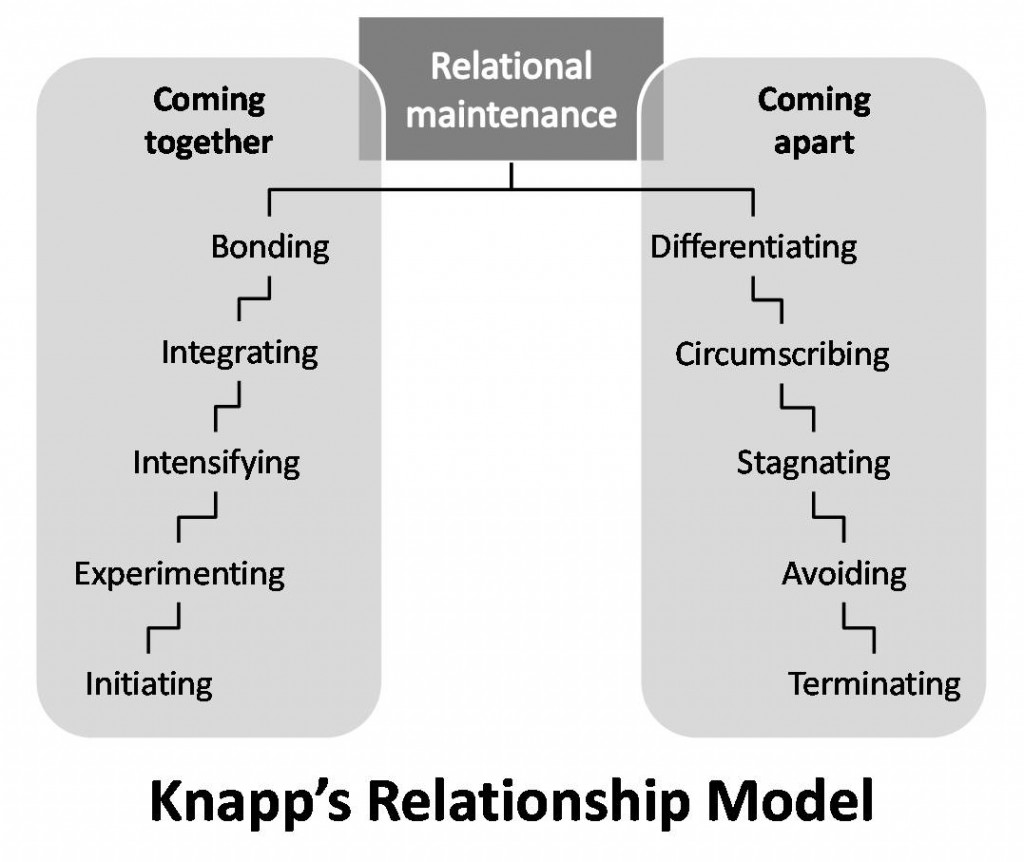
Knapp divided relationships into two main phases: coming together and coming apart.
Coming Together
- Initiating: Meeting someone for the first time. Example: Saying hello to a new coworker.
- Experimenting: Getting to know each other through small talk. Example: Asking about hobbies or favorite movies.
- Intensifying: Sharing personal feelings and forming emotional bonds. Example: Confiding in a friend about a difficult experience.
- Integrating: Lives start to overlap; others see you as a pair. Example: Friends or family treating you as a couple.
- Bonding: A formal commitment, like marriage or a lifelong partnership. Example: Moving in together or exchanging vows.
Coming Apart
- Differentiating: Focusing on differences instead of commonalities. Example: Arguing more frequently over habits.
- Circumscribing: Communication decreases, and topics become limited. Example: Avoiding personal discussions to prevent conflict.
- Stagnating: Relationship feels stuck, little growth or excitement. Example: Spending time together out of routine, not enjoyment.
- Avoiding: Physical or emotional distance grows. Example: One partner spending most of their time elsewhere.
- Terminating: Relationship ends. Example: Breaking up or ending a friendship.
Where It Came From
Mark L. Knapp, a communication scholar, developed this model in the 1970s to study interpersonal communication and relationship dynamics. He observed that relationships follow predictable patterns of growth and decline, which can help people understand and manage their own relationships.
Key Takeaway
Relationships evolve in stages—from meeting to deep connection, and sometimes to ending—and being aware of these stages helps navigate them more effectively.
Knapp's Relationship Model is a seminal framework in interpersonal communication and social psychology that maps the development and deterioration of personal relationships through a series of structured stages. Developed by Mark L. Knapp in the 1970s, the model identifies ten stages divided into two main phases: coming together (initiating, experimenting, intensifying, integrating, bonding) and coming apart (differentiating, circumscribing, stagnating, avoiding, terminating). Each stage is characterized by specific communicative behaviors, emotional intensity, and relational dynamics, offering a structured lens to understand relational progression over time.
Expert-Level Connections
- Social Penetration Theory: Knapp's intensifying stage parallels the concept of self-disclosure in Altman and Taylor's Social Penetration Theory, where relationships deepen through gradual sharing of personal information.
- Attachment Theory: Patterns observed in the integrating and bonding stages resonate with Bowlby’s secure attachment framework, emphasizing the role of emotional intimacy and trust in sustaining relationships.
- Relational Dialectics: Knapp’s differentiating and circumscribing stages reflect the tension between autonomy and connection described in Baxter and Montgomery’s relational dialectics theory.
- Uncertainty Reduction Theory: The initiating and experimenting stages align with Berger and Calabrese’s theory, where individuals seek information to reduce uncertainty about new social interactions.
- Conflict and Communication Studies: The stagnating and avoiding stages highlight the interplay between communication breakdowns and relational deterioration, informing conflict resolution strategies.
- Developmental Psychology: Knapp’s model demonstrates life-span implications of relational development, showing how early-stage communication patterns can affect long-term relational stability.
Applications
Knapp’s model is widely applied in counseling, organizational behavior, social psychology, and interpersonal communication research. Understanding the stages allows practitioners to predict relational trajectories, improve communication strategies, and intervene in conflict situations.
References
- Knapp, M. L. (1978). Social Intercourse: From Greeting to Goodbye. Allyn & Bacon.
- Altman, I., & Taylor, D. A. (1973). Social Penetration: The Development of Interpersonal Relationships. Holt, Rinehart & Winston.
- Bowlby, J. (1969). Attachment and Loss, Vol. 1: Attachment. Basic Books.
- Baxter, L. A., & Montgomery, B. M. (1996). Relating: Dialogues and Dialectics. Guilford Press.
- Berger, C. R., & Calabrese, R. J. (1975). Some Explorations in Initial Interaction and Beyond: Toward a Developmental Theory of Interpersonal Communication. Human Communication Research, 1(2), 99–112.
- Canary, D. J., & Dindia, K. (2013). Sex Differences and Similarities in Communication. Routledge.