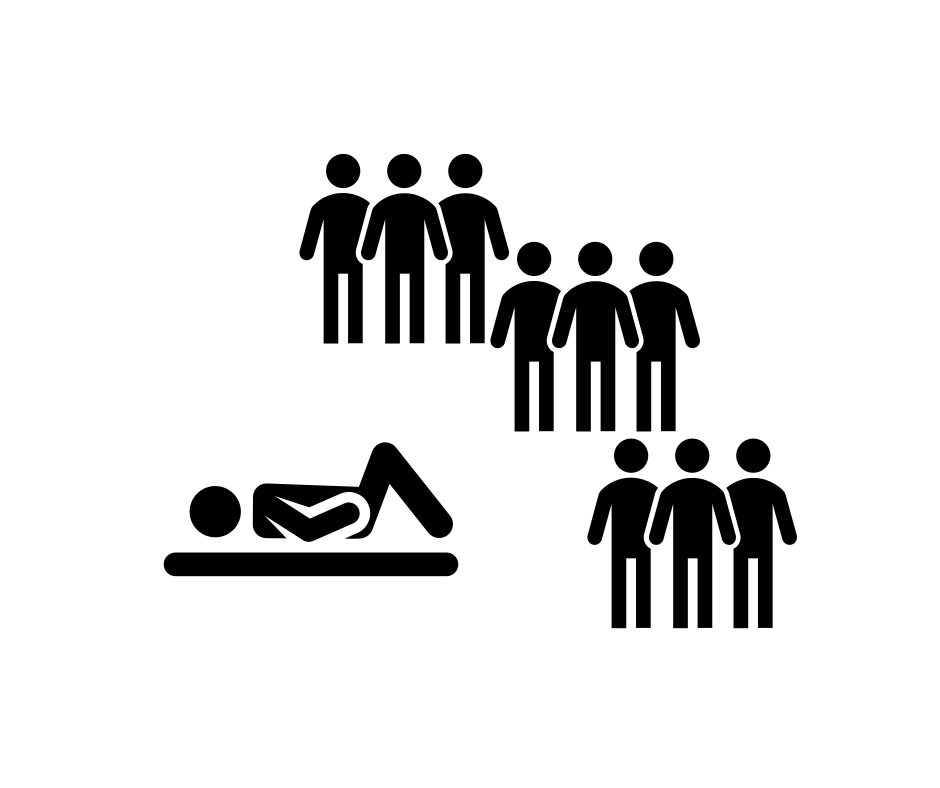
Bystander Effect
What is it?
The Bystander Effect is a psychological phenomenon where people are less likely to help someone in need when other people are present, because responsibility feels shared among the group
The Bystander Effect means that when many people see a problem, each person assumes someone else will handle it — so no one does.
Simple examples
- Someone drops their groceries in a busy parking lot. Everyone sees it, but keeps walking, thinking “someone else will help.”
- A phone rings loudly in a meeting. Nobody answers because everyone assumes it’s not their responsibility.
- A person falls on the sidewalk. If only one person is nearby, they usually help. If a crowd is there, people hesitate, waiting for someone else to act.
- An online group chat — someone asks a question, but no one replies because each person assumes others will.
In short
The more witnesses there are, the less likely any one person is to step in.
The Bystander Effect is a social-psychological phenomenon in which the presence of others reduces an individual’s likelihood of intervening in an emergency. Rather than prompting collective action, group presence diffuses personal responsibility, leading to inaction.
Core Mechanisms
Diffusion of Responsibility When multiple people witness a situation, each individual feels less personally accountable for taking action. Responsibility is psychologically “spread out” across the group.
Pluralistic Ignorance Individuals look to others for cues on how to behave. If no one else appears alarmed, each person concludes that action is unnecessary—even when everyone privately feels concern.
Social Conformity Effects Related to normative social influence, people avoid acting in ways that might appear inappropriate or embarrassing if others are not acting.
Cost–Benefit Evaluation From a behavioral economics perspective, individuals subconsciously weigh the personal costs of intervention (risk, effort, embarrassment) against uncertain benefits, often deciding not to act when others are present.
Connections to Other Scientific Principles
Social Loafing Similar group dynamics occur in teamwork: individuals exert less effort when responsibility is shared.
Game Theory (Public Goods Problem) Helping in emergencies resembles contributing to a public good. Each person benefits if someone helps, but acting carries individual cost — creating a free-rider problem.
Cognitive Load and Attention In crowded environments, attention is divided, reducing situational awareness and delaying reaction.
Evolutionary Psychology Some researchers suggest hesitation in group danger situations evolved as a risk-avoidance strategy — waiting to see how others respond before acting.
Moral Responsibility and Agency Philosophical discussions of agency show that perceived shared responsibility weakens moral obligation to act.
Practical Implication
The most reliable way to counter the bystander effect is to assign responsibility directly — for example, calling on a specific person: “You in the blue jacket, call emergency services.” This re-establishes personal accountability.
References
- Darley, J. M., & Latané, B. (1968). Bystander intervention in emergencies: Diffusion of responsibility. Journal of Personality and Social Psychology, 8(4), 377–383.
- Latané, B., & Darley, J. M. (1970). The Unresponsive Bystander: Why Doesn’t He Help? New York: Appleton-Century-Crofts.
- Latané, B., Williams, K., & Harkins, S. (1979). Many hands make light the work: The causes and consequences of social loafing. Journal of Personality and Social Psychology, 37(6), 822–832.
- Bicchieri, C. (2006). The Grammar of Society: The Nature and Dynamics of Social Norms. Cambridge University Press.
- Ostrom, E. (1990). Governing the Commons: The Evolution of Institutions for Collective Action. Cambridge University Press.
- Kahneman, D. (2011). Thinking, Fast and Slow. Farrar, Straus and Giroux.
- Bandura, A. (1999). Moral disengagement in the perpetration of inhumanities. Personality and Social Psychology Review, 3(3), 193–209.